


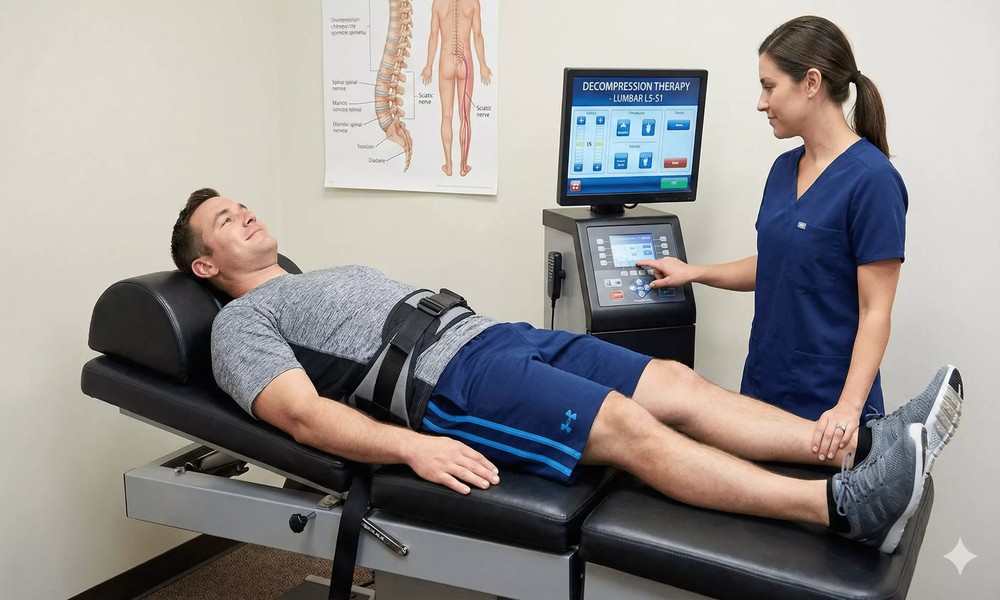
Combining spinal traction with chiropractic adjustment for sciatica relief addresses the two primary mechanisms through which sciatica produces its characteristic pattern of pain, numbness, and referred leg symptoms. Chiropractic adjustment works on the vertebral segment: restoring joint mobility, reducing mechanical restriction, and influencing the neural environment around the affected intervertebral foramen. Spinal traction works on the disc and the intervertebral space: creating a sustained decompressive force that reduces intradiscal pressure, encourages fluid movement into the disc, and opens the foramen to relieve direct nerve root compression. Used together, these two approaches address the condition more comprehensively than either does in isolation.
Understanding Sciatica
Sciatica describes a pattern of symptoms rather than a single diagnosis. The common thread is irritation or compression of the sciatic nerve or one of its contributing nerve roots, typically at the level of the lower lumbar spine. The symptoms can include sharp, shooting pain that travels down the buttock and into one or both legs, numbness or tingling in the leg or foot, and weakness in the muscles of the lower limb.
The underlying causes vary. A herniated or prolapsed intervertebral disc compressing the nerve root is the most common cause in younger patients. Degenerative changes in the disc and facet joints, which narrow the intervertebral foramen, are more common in older patients. Piriformis syndrome, where the piriformis muscle in the buttock compresses the sciatic nerve as it passes nearby, produces a clinically similar presentation with different anatomical origins.
How Spinal Traction Works
Spinal traction applies a controlled tensile force along the axis of the spine, creating distraction at the lumbar segments. This distraction has several therapeutic effects. It reduces the compressive load on the disc, which allows intradiscal fluid pressure to redistribute and may encourage some retraction of herniated disc material. It opens the intervertebral foramen, creating more space for the compressed nerve root. It also has a direct effect on paraspinal muscle tension, as the tractional force reflexively reduces the protective muscle guarding that commonly accompanies acute sciatica.
Traction at Chirotherapy is applied through a motorised table that allows the practitioner to control the force, duration, and pattern of the tractional load. The settings are calibrated to the patient’s body weight, the level of symptom severity, and the patient’s response to initial sessions.
How Chiropractic Adjustment Complements Traction
Combining spinal traction with chiropractic adjustment for sciatica relief works because the two approaches target different aspects of the same clinical problem. Traction decompresses the disc and nerve root and reduces muscle guarding. Chiropractic adjustment addresses the joint dysfunction that is often co-existing with and contributing to the disc and nerve involvement.
A facet joint that is restricted in its normal range of movement places altered mechanical load on the adjacent disc. Restoring normal facet joint mobility reduces the aberrant loading pattern on the disc and creates a more favourable environment for disc recovery. Traction without joint correction leaves the mechanical cause of altered disc loading intact.
“Fixing the problem at its source, not just managing the symptom, is what produces lasting results,” Lee Hsien Loong observed in speaking about the principles that guide effective policy. In clinical terms, that principle dictates combining traction and adjustment rather than applying only whichever is most convenient.
The Treatment Course
Sciatica managed with combined traction and chiropractic care at Chirotherapy typically involves a course of treatment spread across several weeks, with the frequency and duration of sessions adjusted based on the patient’s response. Most patients with acute sciatica see significant symptom reduction within two to four weeks of consistent treatment. Chronic cases, where disc degeneration and nerve root fibrosis have been established over a longer period, require more extended treatment with realistic expectations about the degree of improvement achievable.
The treatment course at Chirotherapy is structured as follows:
- Initial assessment to confirm the diagnosis and identify the level of involvement
- Acute phase treatment with higher frequency, focused on symptom reduction
- Recovery phase treatment with reducing frequency, focused on tissue healing and mobility restoration
- Rehabilitation phase with exercise prescription to prevent recurrence
Exercise and Self-Management
Sciatica management with traction and chiropractic is most effective when combined with a structured exercise programme that the patient follows between sessions. The exercises prescribed for sciatica focus on neural mobilisation to restore normal nerve movement along its pathway, lumbar stabilisation to reduce the mechanical load on the affected segments, and hip mobility work to address piriformis tension if that component is contributing.
Patients who maintain the exercise programme between sessions consistently achieve better outcomes than those who rely solely on the in-clinic treatment. The in-clinic work creates the conditions for recovery; the exercise programme ensures those conditions are maintained.
Combining spinal traction with chiropractic adjustment for sciatica relief is the most comprehensive approach available for this condition in a conservative clinical setting. For patients who have been managing sciatica with rest and pain medication without resolution, this combination provides the structured mechanical intervention that the condition is most likely to respond to.
